
Internal Accountability Under Fire: Chanthavy Tornado’s Public Call‑Out of Verity’s Leadership
A CSEC advocate’s viral post reignites scrutiny of power, equity, and harm inside Sonoma County’s largest rape crisis center.

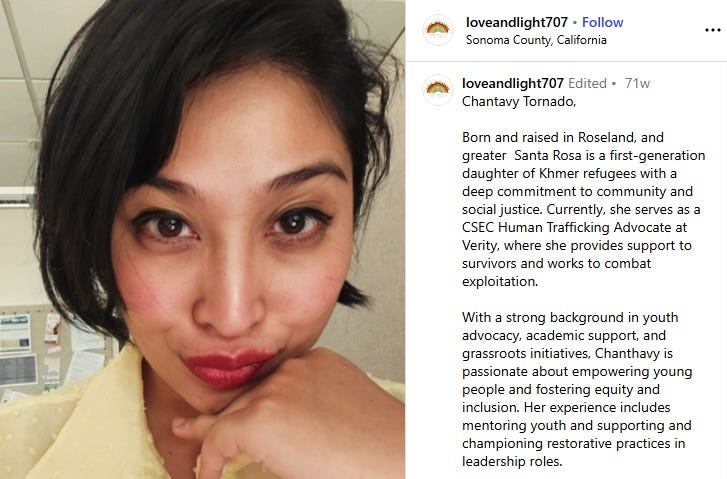
In a widely shared social media post, Chanthavy Tornado, a CSEC Human Trafficking Advocate at Verity and a first‑generation daughter of Khmer refugees, publicly criticized the organization’s leadership and internal culture. Her post, published on the account loveandlight707, called for a financial audit, leadership accountability, and the removal of Executive Director Rebecca Fein.
The post struck a nerve across Sonoma County’s advocacy community, where concerns about inequity, favoritism, and internal harm within nonprofits — especially those serving marginalized communities — have been simmering for years.
A Direct Challenge to Nonprofit Power Structures
Tornado’s message centers on a core argument: nonprofits cannot claim to serve marginalized communities while replicating oppressive systems internally.
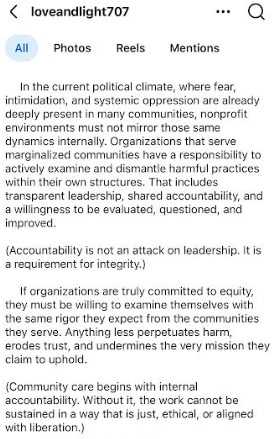
Her post states that organizations must:
Examine their internal structures
Address inequitable practices
Ensure leadership is transparent and accountable
Avoid replicating the same power dynamics they claim to fight
She emphasizes that accountability is not an attack, but a requirement for integrity.
This framing reflects a growing national conversation about nonprofit accountability, particularly in organizations that work with survivors of violence, trafficking, and systemic oppression.
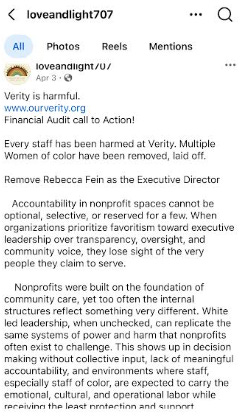
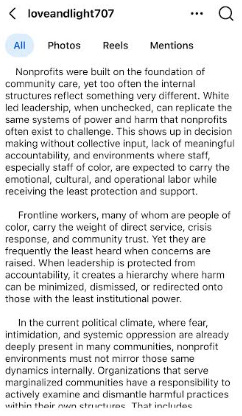
Allegations of Favoritism and Harm
Tornado’s post specifically criticizes Verity’s leadership for:
Favoritism
Lack of transparency
Failure to protect staff of color
Retaliatory or dismissive internal practices
Leadership that resists evaluation or shared decision‑making
She argues that these dynamics create an environment where harm is not only possible but predictable — especially for frontline workers and women of color.
Her call for a financial audit and the removal of the Executive Director signals a belief that the issues are not isolated but systemic.
The Stakes for Staff of Color
Tornado’s post highlights a reality long reported by workers in Sonoma County’s nonprofit sector: women of color often bear the brunt of inequitable practices.
She writes that unchecked leadership can:
Silence staff
Punish dissent
Create unsafe working conditions
Undermine the mission of serving survivors
Her critique reflects a broader pattern in which staff of color in nonprofits — especially those in direct‑service roles — report:
Being overworked
Being underpaid
Being excluded from decision‑making
Being retaliated against when raising concerns
Tornado’s post positions these issues not as interpersonal conflicts but as structural failures.
A Call for Structural Change
Tornado argues that community care begins with internal accountability, insisting that nonprofits must:
Share power
Invite evaluation
Accept critique
Prioritize ethical leadership
Align internal practices with their public values
She warns that without internal accountability, nonprofits risk mirroring the same oppressive systems they claim to dismantle.
Her message resonates with many advocates who have long argued that Sonoma County’s nonprofit sector — particularly in the violence‑prevention and survivor‑services space — has struggled with transparency and equity.
Why This Post Matters
Tornado is not an outsider criticizing from afar. She is:
A frontline advocate
A woman of color
A first‑generation daughter of refugees
Someone working directly with trafficking survivors
Her perspective carries weight because she is embedded in the work — and because she is speaking publicly despite the risks.
In a county where nonprofit leadership is often insulated from scrutiny, her post represents a rare and bold act of whistleblowing.
Community Response and Broader Implications
The post has circulated widely among:
Advocates
Survivors
Former Verity staff
Community organizers
Nonprofit workers across Sonoma County
Many have interpreted it as part of a larger reckoning with:
Power imbalances
Racial inequity
Lack of oversight
Harm within organizations meant to protect survivors
Tornado’s call for a financial audit and leadership change suggests that internal reform may no longer be viewed as sufficient — and that community members are demanding structural accountability.