
FPPC Opens Enforcement Case Into Santa Rosa Assistant City Attorney Kelly Leonhardt
State watchdog opens inquiry into undisclosed income tied to a firm now suing the City she serves.

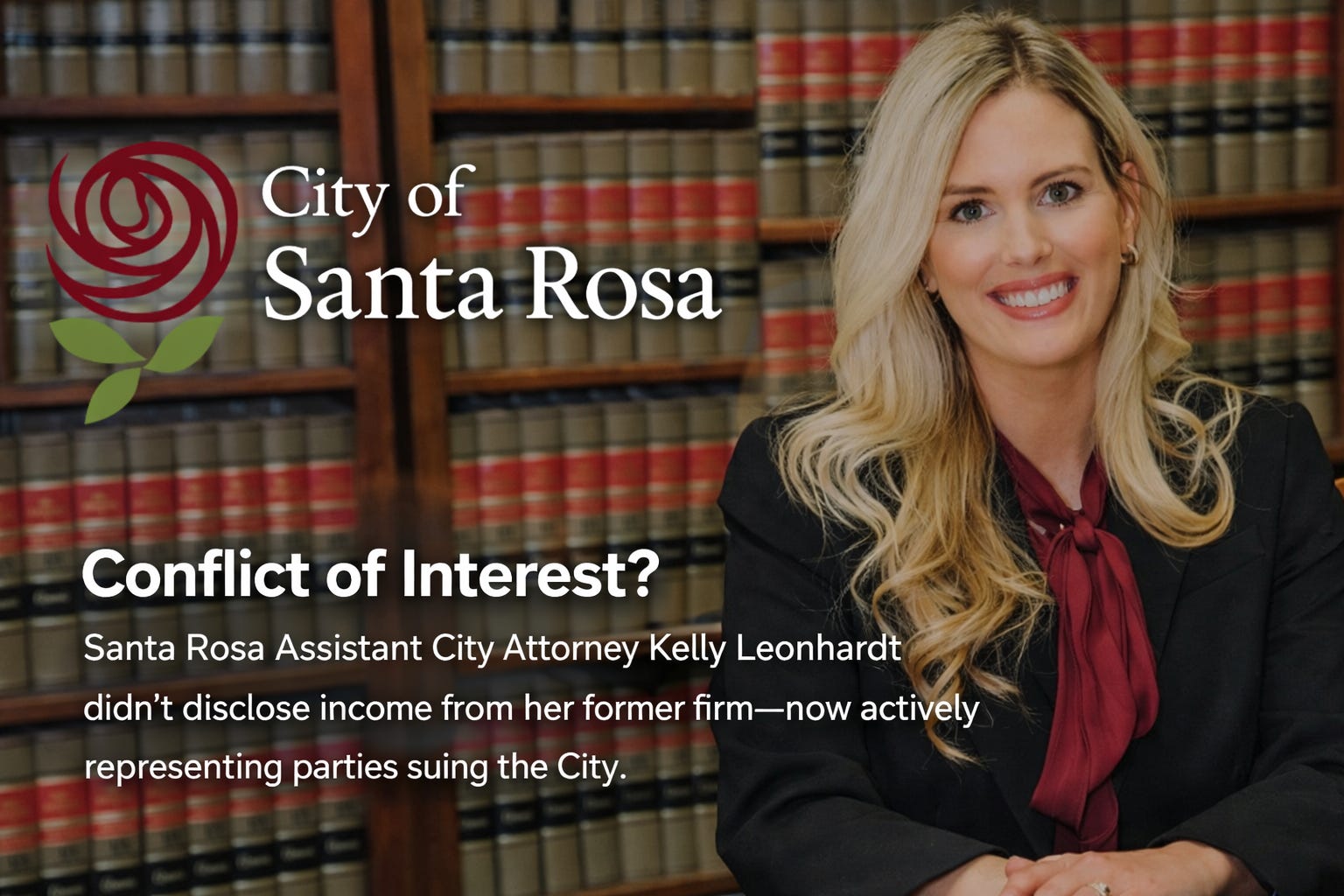
The Fair Political Practices Commission (FPPC) has formally opened an enforcement case into Santa Rosa Assistant City Attorney Kelly Leonhardt following a sworn complaint alleging she failed to disclose income from her former law firm—Krankemann Law Offices P.C.—which is now actively suing the City of Santa Rosa. The FPPC’s decision marks a significant escalation in a conflict‑of‑interest issue that has raised public transparency concerns across Sonoma County.
The case has been assigned FPPC Case No. 2026‑00366.

FPPC Confirms Investigation Is Underway
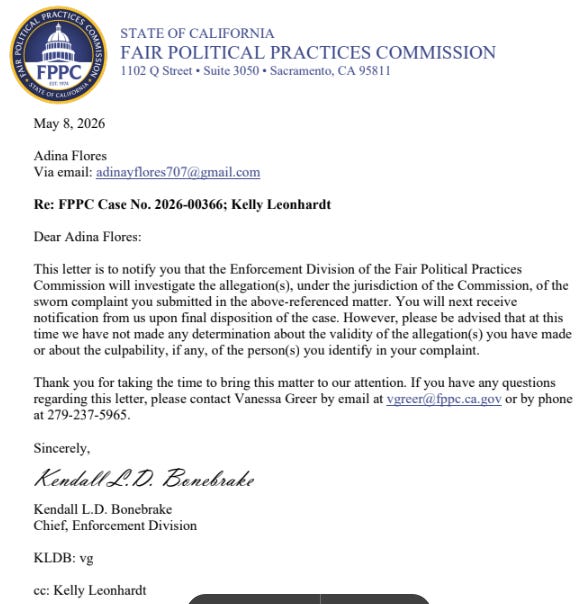
On May 8, 2026, the FPPC Enforcement Division sent a formal notice confirming that the agency will investigate the allegations raised in the sworn complaint.
In the letter, FPPC Enforcement Chief Kendall L.D. Bonebrake wrote:
“This letter is to notify you that the Enforcement Division of the Fair Political Practices Commission will investigate the allegation(s)… of the sworn complaint you submitted.”
The letter also clarifies that the FPPC has not yet made any determination about the validity of the allegations:
“At this time we have not made any determination about the validity of the allegation(s) you have made or about the culpability, if any, of the person(s) you identify.”
This is the standard language used when the FPPC accepts a complaint for investigation—signaling that the matter has met the threshold for jurisdiction and review.
Background: The Alleged Conflict of Interest
Leonhardt’s Employment Timeline
According to the documents you provided and the public record:
Leonhardt worked for Krankemann Petersen LLP / Krankemann Law Offices P.C. until August 2024.
She joined the Santa Rosa City Attorney’s Office in September 2024, later becoming Assistant City Attorney.
Her Form 700 Statement of Economic Interests does not disclose income from her former firm.
Under California’s Political Reform Act, public officials must disclose:
Income over $500 from any source within the 12 months prior to assuming office
Any business positions
Any financial interests that could foreseeably be affected by their official duties
If Leonhardt received income from Krankemann Law after September 2023, it should have appeared on her Form 700.
Why the FPPC Case Matters
1. The Firm She Worked For Is Suing the City She Represents
Krankemann Law Offices P.C. represents plaintiff Pamela Kezer in:
Kezer v. City of Santa Rosa, Case No. 25CV07259
The City of Santa Rosa is a named defendant.
The case is active.
The firm personally served the City on March 19, 2026.
This means:
Leonhardt’s former employer
Is now adverse to her current client (the City)
In litigation filed after she joined the City Attorney’s Office
While she did not disclose income from that firm
This is precisely the type of scenario the FPPC’s conflict‑of‑interest rules are designed to prevent.
Krankemann’s Response
Attorney Walter Christian (“Chris”) Krankemann provided a statement asserting:
Leonhardt left his firm in August 2024
The Kezer lawsuit was filed after her departure
She has received no compensation from the firm since leaving
These statements are relevant—but they do not resolve the underlying legal issue.
Why the Conflict Question Remains Unresolved
1. FPPC Disclosure Rules Still Apply
Even if Leonhardt left before the lawsuit was filed, the FPPC requires disclosure of any income received within 12 months of assuming office.
Leonhardt joined the City Attorney’s Office in September 2024.
Any income from the firm after September 2023 should have been reported.
2. The Appearance of Divided Loyalty
Disclosure laws exist to protect public trust—not just to document active payments.
The public sees:
A City Attorney
Formerly employed by a firm
That is now suing the City she represents
Even if no wrongdoing occurred, the optics alone raise legitimate concerns.
3. The City Attorney’s Office Must Avoid Even the Appearance of Impropriety
The public cannot evaluate the integrity of the City’s legal strategy if they are unaware of undisclosed financial relationships.
The FPPC’s Role Moving Forward
The FPPC will now:
Review the sworn complaint
Examine Leonhardt’s Form 700 filings
Evaluate whether disclosure rules were violated
Determine whether enforcement action is warranted
The agency emphasized that no conclusions have been reached.
A final determination will be issued at the end of the investigation.
Broader Implications for Transparency in Sonoma County
This case fits into a broader pattern of concern:
Attorneys moving between public and private roles
Firms litigating against agencies they previously advised
Inconsistent compliance with disclosure requirements
The FPPC’s decision to open a case signals that these concerns are not merely political or rhetorical—they fall squarely within the state’s enforcement jurisdiction.
“For nothing is hidden that will not be made manifest, nor anything secret that will not be known and come to light.” — Luke 8:17